Easy Exercises To Do Outdoors By Mirabai Holland, MFA © 2013

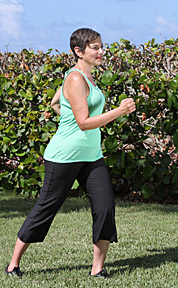
I love to get out and walk outdoors. Even if you haven’t done much over the winter, the green smell of plants and flowers in the air and switching on to daylight savings time are great motivators.

Start with a duration you’re comfortable with and work your way up. I do some standing pushups and a couple of stretches at the end of my walk to round out the workout. No equipment necessary, just your favorite tree. Here is what I do:


Standing Pushups: Stand facing your tree and stretch arms in from of you, chest level and place hands on the tree a few inches apart. Keeping your body straight, slowly bend elbows until your chest is close to the tree and push back with a single thrust.


Work up to 20 reps. Works chest, and arms.


Back Extention: Stand facing your tree and stretch arms in front of you slightly below chest level.
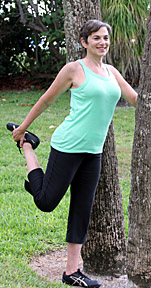
Place hands on the tree a few inches apart. Keep arms stretched as you bend back lifting your head chin up while contracting your abs. Hold for 10-20 seconds. Stretches back.


Front Thigh Stretch: Stand facing your tree and hold on with your left hand. Grab your right ankle and gently pull heel towards buttocks. Hold for 10-20 seconds. Then switch legs.  Stretches the front thigh muscles.


Enhanced by Zemanta
Share this:
Share this page via Email Share this page via Stumble Upon Share this page via Digg this Share this page via Facebook Share this page via Twitter
Share

Easy Exercise Video by Mirabai Holland Get Started With Just 5 minutes

Get started right now with a 5 minute Easy exercise video for women over 40 looking for a beginner exercise routine.  Based on my Moving Free Technique which combines the joy of dance with the science of exercise. Shape-up, burn calories, build stamina, strength and flexibility. Ease into the best shape of your life.

As a beginner, exercises should be easy. Getting fit doesn’t have to feel like getting your teeth drilled. My easy exercises disconnect the pain from the gain.  If you enjoy exercising today you’ll look forward to doing it tomorrow.

For more information on my Ease-in System please click here

Enhanced by Zemanta
Share this:
Share this page via Email Share this page via Stumble Upon Share this page via Digg this Share this page via Facebook Share this page via Twitter
Share

It’s Fashion Flash Monday, May 20th by Mirabai Holland 2013

Today’s Fashion Flash Host is Barbara Hannah Grufferman author of The Best of Everything After 50. Her website is your source of for all things after 50.

Our Fashion Flash team has been prospecting for nuggets of knowledge and fab deals for women over 40. Check out our finds and let us know what you think.

“Getting fit shouldn’t feel like getting your teeth drilled.” It that statement resonates with you my Ease-in System may be what you are looking for. “You can ease into the best shape of your life!” For more info Click here

Share this:
Share this page via Email Share this page via Stumble Upon Share this page via Digg this Share this page via Facebook Share this page via Twitter
Share

Fitness & Wellness Q & A’s by Mirabai Holland, MFA ©2013

Here are three fitness and wellness Q & A’s that I’d like to share with you this week. I’d love to hear your comments and feel free to send me your questions too.

Q: I am in fairly decent shape at 62. I stay active and exercise. What does it mean when I hear my bones sometimes “crack” when I do some movements? I do not ever feel pain. Will the exercise help and maybe stop the popping?

A: Exercise is good for both the body and mind, but it probably won’t stop the popping.  People of all ages and fitness levels experience that popping sound; and it doesn’t necessarily indicate any abnormal condition. Your joints are lubricated with a substance called synovial fluid. It contains nitrogen, oxygen and carbon dioxide gasses. The popping sound is actually bubbles of those gasses escaping when you move your joints. This is normal and nothing to worry about. But people who feel pain at those moments should consult their doctors. They may have arthritic joints due to the loss of cartilage.

 Q: I am in my 40’s with a high stress job. I exercise at the gym at work at least 3 times a week. I try not to bring work home with me but I am always tense and I have trouble sleeping at night. My mind is racing. Warm milk hasn’t worked, bubble baths make me tenser and I don’t want to take drugs. Any ideas?

A: You are not alone. Stress is one of the main contributors to aging and disease. It sounds like you have a build-up of stress so it’s important to relieve tension at work as well as when you are trying to fall asleep. Try this breathing exercise at work and then again as you are lying in bed. It should help relax you and slow down your thoughts. Start with taking a breath and holding it for three seconds and then exhaling. Repeat and hold for 4 seconds and continue each time holding a second longer until you get to ten seconds. After the last breath, keep your eyes closed and focus on a peaceful memory. A place or time when you felt most relaxed. Stay there as long as you can or at night until you fall asleep.

Q: I need to lose 20 pounds. I am doing aerobics three times a week and watching my calories but I am losing so slowly, I was wondering if there is any other type of exercise that could help me lose weight faster? I am really getting frustrated and I am almost ready to just give up.

A: Try adding 2-3 days of weight training to the mix. Studies show the winning formula is a combination of aerobic and weight training exercise. Moderate aerobic exercise burns calories while you are doing it and for a short time afterwards. Weight training burns calories too but it also increases your lean muscle mass. So as you add more muscle, you’ll burn more calories all day long. Research from Tufts University found that after 12 weeks of weight training, total calorie burning increased by about 15 percent which for an average adult, could amount to an extra 240 to 400 calories a day.

For more info about Mirabai and her Moving Free Technique go to www.mirabaiholland.com


Share this:
Share this page via Email Share this page via Stumble Upon Share this page via Digg this Share this page via Facebook Share this page via Twitter
Share

Fashion Flash Monday, October 22, 2012 by Mirabai Holland, MFA

Our Fashion Flash host this week is Jodell Raymond, Fashion Maven and author of the Plus Size Fashion Blog  provides the latest fashion news and info. Her collection of wonderful tasteful clothes for Plus Size Women is available at BlackCatPlus. As for the rest of us Fashion Flashers, this week we provide the best in Beauty, Fashion, Health and Fitness info.  Check us out!


Share this:
Share this page via Email Share this page via Stumble Upon Share this page via Digg this Share this page via Facebook Share this page via Twitter
Share

The Pleasure Principle

Summer is upon us and we’re scrambling to get into shape. So I thought I would talk about one of the most important aspects of any fitness program, pleasure.
If you like it, you’ll do it. If you don’t, you won’t.
The popular trend right now in the fitness industry is boot camp style workouts that basically whip you into shape.
This type of exercise may be some people’s idea of fun, but for many of us who have had trouble getting or staying on an exercise program it’s just not sustainable.
Exercise should be a pleasure not a chore.
That thought played over and over in my head as I watched two distinct sets of bicyclists on their daily rides.
Near where I live there is a road that has two bike paths on it. There is one for serious touring bikers and one for slower traffic.

The serious group is just that, SERIOUS! – Featherweight bikes with drop handle bars, tiny seats and pedals that require clip-on shoes. They wear flaming color form fitting hi-tech clothes that slip the air, wick the sweat and have hidden pockets for keys and snacks.
They stream along at high speed, and with their bodies bent over for aerodynamic position, helmeted heads lurched forward, they look like a flock of supersonic tropical birds. There is a grimace on every face, but this is the type of exercise they enjoy.
They’re working hard and wouldn’t have it any other way. Young or old, these athletes are in top condition.
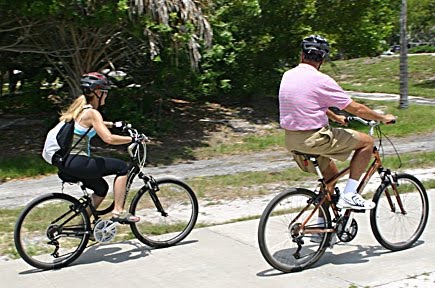
However, just a few feet away, an endless parade of more leisurely exercisers ambles along, peddling merrily, sitting up right, zinging their bells, smiling and chatting. They wouldn’t have it any other way either.

Are the amblers as fit as the racers? – Probably not. But is their daily moderate exercise enough to reap most of the health benefits exercise has to offer? – Probably so.
Research clearly shows that you don’t have to be an athlete to be fit enough to be healthy and live longer.

Then there’s burnout. If you don’t enjoy it you’ll quit.
So many of us try to do too much and end up doing nothing.
Pleasure is the key to success.
Find a physical activity you like or at least don’t hate and pursue it with pleasure. Stay in your comfort zone and if you do, exercise will become something you look forward to instead of dread.
Share this:
Share this page via Email Share this page via Stumble Upon Share this page via Digg this Share this page via Facebook Share this page via Twitter
Share


Moving Free® with Mirabai
Best Exercises For Skeletal Fitness
By Mirabai Holland, MFA ©2010

www.movingfree.com

Mirabai Holland MFA is one of the leading authorities in the Health & Fitness industry, and public health activist who specializing in preventive and rehabilitative exercise for women. Her Moving Free® approach to exercise is designed to provide a movement experience so pleasant it doesn’t feel like work.
Osteoporosis is one of those silent diseases that can creep up on you before you know you have it. To combat Osteoporosis and help keep your bones healthy for a lifetime, it’s important to increase your Skeletal Fitness!
Osteoporosis is a disease, which, over time, causes bones to become thinner, more porous and less able to support the body. Usually there’s no pain in the early stages.
44 million of us are at risk for Osteoporosis. The vast majority are women.
Women often develop Osteopenia (low bone mass that can lead to Osteoporosis) in the first few years after menopause because they lose bone-protecting estrogen.
But, we can prevent and help reverse the effects of Osteoporosis by working out our bones. On the outside, bones look solid and rock-like, but they’re not.
They’re living tissue. There is a smooth, hard, outside layer
made of cortical bone, and the inside, is a strong, light weight,
honeycomb-like structure, called trabecular bone, which contains blood vessels, and bone marrow. The combination of cortical and trabecular bone enables the skeleton to be light, strong, flexible and efficient.

By young adulthood, our bones have grown to their full size and density. But activity in our bones is far from over. In a cycle called remodeling, old and weakened areas of our skeletons are broken down and replaced with new well-formed tissue. Adults have about 10 to 15% of their bone replaced each year.
In bones with Osteoporosis, the remodeling cycle is out of balance. Bone is broken down but little or nothing takes its place. The outside hard cortical layer
gets thinner, and the honeycombed, trabecular inside becomes more porous.
Most people don’t discover they have Osteoporosis until a fracture occurs.
Fractures occur most often at the spine, at the hip, and at the wrist.

The good news is since bones are living tissue they can become denser with weight bearing exercise.
For example, astronauts lose bone mass in the weightlessness of space. To combat this, NASA is training astronauts for a mission to Mars, to do weight bearing exercise that simulates the exercises they will need to do in space to maintain their bone mass. Weight bearing exercise for Skeletal Fitness is called bone loading. When working out your bones it’s important to load the areas most at risk for fracture: the spine, the hip, and the wrist.

So for instance try these Do’s to help load the three areas most at risk:

· Carrying a backpack instead of a purse to help load your spine.
· Take stairs instead of the elevator whenever you can to load your hips.
· Grab some soup cans and do 8-16 reps of wrist curls and when that gets too light invest in some hand weights. Remember; always exhale on exertion when you’re lifting a weight. Start with a comfortable weight and add one pound every couple of weeks, or, when it feels too easy.
· As you get stronger you can add a full body weight-training program with special emphasis on the areas at risk for Osteoporosis.
Weight train every other day, because your body needs time to recover and grow stronger.

If you are at risk for or have Osteoporosis, here are some Don’ts
· As a general rule, don’t do anything that requires you to bend forward from the waist with the back rounded; this is called spinal flexion and increases the risk of collapsed vertebra so no toe touches.
· Avoid sit-ups, and crunches. Instead, you can strengthen your abdominals by keeping them pulled in, navel back to your spine during daily activity.

Also, always consult with your doctor, get all the information you can, together you can decide what’s best for you. The National Osteoporosis Foundation has great info at www.nof.com
And remember, it’s never too early or too late to start working out your bones!
For more information on bone-loading workouts please visit www.movingfree.com

Share this:
Share this page via Email Share this page via Stumble Upon Share this page via Digg this Share this page via Facebook Share this page via Twitter
Share